

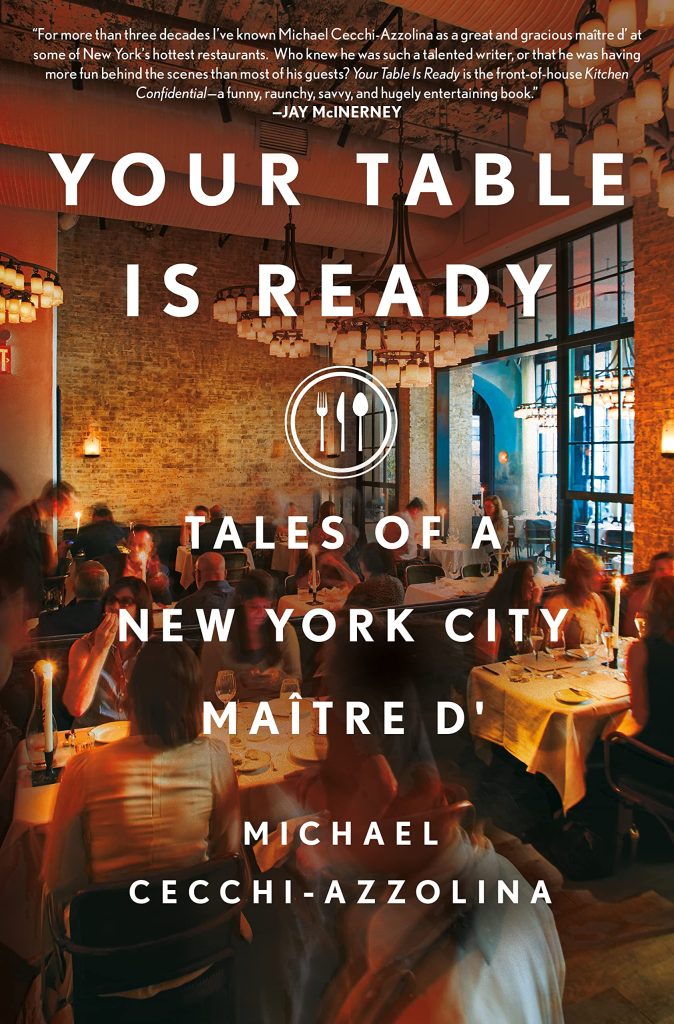
Elena Bowes spoke with Michael Cecchi-Azzolina, about his memoir, Your Table is Ready: Tales of a New York City Mâitre D’. His book is the front of house equivalent to Anthony Bourdain’s Kitchen Confidential.
Your Table is Ready describes the heady 1980’s, think of Michael Douglas in the film Wall Street, Gordon Gekko, Greed is Good Days, before social media, before the Me Too movement when money, booze, cocaine, and sex flowed like tap water.
Michael, a natural storyteller, has had a front row seat at both the good and the bad times in the city. He lost a lot of friends during the AIDS crisis, and 20 years later he lost beloved clients in 9/11.
Below is an edited, abbreviated version of our conversation. You can listen to the full episode here on Elena Meets the Author or wherever you listen to podcasts.
Michael, you have so many choice stories in your book and the Brooklyn mobster accents that you do on the Audible narration are impressive. It makes sense that you also had a career in acting. Let’s start off by talking about the genesis of your book. What made you decide to write it?
I had an acting career for many years. In fact, restaurants supported my theatre habit. As an actor, you’re a storyteller. And when I was at restaurants and working, I told stories. I told stories about life. The wacky things that happened to me, to restaurants, to other guests.
People have come in and people always said, well, you should write this down. So, 30 odd years later, I decided to write it down. I was the maître d’ and manager at Le Coucou (award winning, Michelin star NYC spot). So, once the last table is seated, and there are a couple of nights a week I had to close the restaurant, I really had nothing to do.
So, I’m standing there, and I figured, let me start writing. And I did. I went in the back and started typing away. And I got about 70 pages in and one of my guests, a known food writer, was walking out one day and I said, you know, I think I’m writing a book. Can I send it to you? And, let me know what you think.
And he said, yeah, sure, of course. So, I did, and he sent it back a few days later with notes. And he said, you need to do this, this, and this. So I responded to the notes, and we had a back and forth for about three or four weeks.
I probably wrote another hundred pages. Then he said, okay, that’s it. Stop bothering me. You’re a writer. Go finish your book. At that time, my young daughter was born. And I was working full time, I had a newborn, and I stopped writing.
And about a year and a half later, COVID happens. And I lost my job. And my wife and I, and some family members and our daughter, went up to a farm in the middle of nowhere in upstate New York. And we’re up there, and while I’m up there, a former host of mine sends me an email from someone out in L.A. whose offering writing scholarships to any restaurant worker that’s a writer and happens to be unemployed. How’s that for a niche? So, I applied, for this writing scholarship, I got it, and it was a ten-week workshop where you had to commit to two hours in the morning and two hours at night.
We met remotely two or three nights a week, we’d have these talks with other writers who were in the program. Probably about eight of us were doing it. I finish the ten-week program, and at the end of it, you get an evaluation. And I’m now at this farm in the middle of nowhere, the only, reception I got on my phone was in the middle of a cow field.
So, I take a chair, and I trudge out to the middle of a cow field, I sit down. Phone rings, I get the evaluation, and it was very good. So, I hang up the phone, and I’m thinking, now what? The cows are looking at me, we’re in the middle of COVID, and my phone rings. And it’s a former customer of mine, calling to check in.
How are you? What’s going on? What are you doing? And I say, you know, I’m well, broke, haven’t worked in a long time, but I just finished a book. He said, What’s the book? I said, It’s a front of house kitchen confidential. He goes, Oh, that sounds interesting. I say, Well, if you happen to know any literary agents, let me know.
He says, you know, I know a few. let me see what I can do for you. I hang up the phone. The next day I get an email from a literary agent saying I heard I should read your book. I send him the book. He writes back to me two weeks later. I love it. Stand by. Two weeks after that, he signed me. And then about a month later, we got a publishing deal. And the book came out. Well, it takes about a year. About a year later, the book came out.
Let’s discuss your childhood in Bensonhurst, Brooklyn, and how serving at your uncle’s poker games and being an altar boy gave you a sense that maybe the restaurant business could be for you.
When I started to write the book, I started thinking, how did I get into this business, how did I get to be a waiter? I just started thinking, and I kind of always did it. I was an altar boy. And when you’re an altar boy, you serve Mass. And what’s serving Mass? You assist the priest. You get the wine and the host, and you bring it out. And you get the linens, which are the tablecloths to cover the altar. And you polish the gold. You know? And you set up the cruets with the wine and the water and, you’re there and you’re serving. I thought, well, wow, my restaurant career really started in church.
I come from this very Italian Sicilian background neighbourhood and a lot of poker playing, booze drinking guys. On the weekends, my mother played poker, and these guys would come over for poker games. They would come sit in the living room, and they’d be smoking cigarettes, and they’d be drinking, and I thought, I’d like to hang out with those guys.
It was kind of cool. I must have been six or seven years old, and I would change the ashtrays. If they needed a drink, I’d run in the kitchen, get them a drink, and there I was serving drinks and cleaning ashtrays, which, until no smoking happened in restaurants, is what you did. And so, I thought, that really was the genesis of it.
And in the altar boy job, there was a little bit of skimming money off the plate?
The neighbourhood I grew up in, you had three paths in life, generally. You were sanitation, police, or mob. And the ethos of the time, whether you were sanitation, police, or the mob, was get what you can. Take what you can get because no one’s going to give it to you.
This is the mentality. It was very tribal, and that’s what I grew up in. And so after mass, we’d sell the Catholic newspaper called The Tablet. it was ten cents a copy, and there we were, these cute altar boys, ten cents a copy, collecting the money, and then the money would come in, and we’d go back in the rectory, and we would take five dollars off the top to buy a nickel bag of pot.
And then we’d go sneak some wine, before the priest coud get it, because the bottle was already open. Actually we’d get six dollars, because five dollars was for the pot, and then we’d go get high behind the church, and then with the last dollar, we’d go to the luncheonette on the corner and get coffee and toast, because we were hungry.
Switching topics here, you mentioned that the closure of Studio 54 in 1980 really helped spawn the restaurant business in New York. How so?
Studio 54 closed and it was the place to go see and be seen. Sex, drugs, everything was there. Well, that closes, what do people do? Keith McNally had created the Odeon restaurant downtown. And it became one of the first of the restaurants to see and be seen.
And he got in this amazing crowd of artists, actors, models, all the beautiful people. Once Studio closed, restaurants became the stomping grounds. So, you’d go in there and you’d spend a lot of money in the night and then go out to the clubs after that.
Food or service, what’s more important in the restaurant business?
Service. You go to a restaurant for a meal, right? But you really don’t. You go to a restaurant for an experience. You go to celebrate a birthday, an anniversary, on a date, to find a date. You’re hungry, yes, but you go because you want to be around people.
And that’s the experience. And the most successful restaurants, at least the ones that I know, when you walk in that door, your shoulders drop. And if it’s done right, you’re in a whole other mindset, You sit down, someone brings you a drink and you get your food, and if that goes seamlessly, it’s wonderful.
And if things are great, and you love your server, and they come over and explain things, and your steak comes out, it’s well done, you’ll forgive a well-done steak.
But if your server’s a jerk, or the person at the door ignores you, or the bartender’s not looking at you for ten minutes, things start off on a bad foot. And even if the food’s delicious, will you really want to go back? If they forgot your appetizers, or they forgot your partner’s drink, or it was a birthday, and they forgot the candle. You’re probably not going to go back.
But if you get the service part right, and your food’s pretty good, you’re on your way to something successful.
Can you tell us what touching the table means?
Touching the table is going to the table and checking on a guest. When I was working at the Water Club, we were making very good money. The best restaurant in the city was Lutèce with Chef André Soltner. Lutèce was considered the best restaurant in America for many years. And we (waiters) could afford their lunch price fix.
Which I think was $25. Which is probably today’s money, about a buck and a half. And so, we would go for lunch. And every time we went, once service ended, we got our food, André Soltner, this mythic four-star being, would go to every single table. And when he came to your table, you felt like you were being blessed by the Pope.
It was remarkable. He had on his clean jacket, he’s got the toque hat on, and you felt great. And I realized, wow, it’s so important that this man came out and said, how’s your meal? How’s your afternoon? It’s very important. So touching the table is going and checking on your guests.
My last question, you say that up to 90% of restaurants fail within the first five years. It’s a tough business. And yet you opened Ceccchi’s in 2023. So, what was your thinking on that?
What was my thinking? I was in quarantine. I wrote a book, the book got published and I was done. I wasn’t going to come back and work for anybody. I tried to open something before, but everything was too expensive. It just didn’t make any sense. The rents were too high, and you couldn’t make ends meet.
My older daughter said, what are you going to do now, Dad? And I said, nothing. And she says, no, you have to open Cecchi’s. And I said, oh, Jesus Christ. And so, I thought about it and slept on it.
And a lot of restaurants had gone out of business during Covid, and no one knew what was going to happen. So, there were a lot of deals to be had. I thought, okay, I’m going to do it. And I found a spot that I fell in love with at a very good price because of the pandemic.
I saw that in covid when people sat outside in 20-degree (Fahrenheit) weather because they wanted to support restaurants, they wanted to see other people, I saw that people will come back to restaurants. I didn’t know to what extent. I knew the fact that I’ve done this for a long time, I’m not an unknown entity, that people would probably come to the restaurant. So, I felt pretty good about it. I didn’t know we would do as well as we’re doing now. And that’s a whole other story. But we’re doing very well.
But it’s a risk. It’s an absolute risk. It’s hard. And a lot of people go into the business, not knowing what they’re doing. I’m here every day. I was here every day for 7 months, 7 days a week. You’re talking 15, 18-hour days. Because I wanted this to be right.
I now take off weekends. But I’m still here Monday through Friday. Start at 8 in the morning, finish at 11 at night. Because you gotta watch what you’re doing. You gotta know what you’re doing. You have to know your customers. You have to know your staff. We haven’t changed staff almost in a year and a half since we opened. It’s the same staff, which is remarkable, but because we’ve created this spot that is welcoming to them. They’re treated well, customers love them, it’s good.
You’ve definitely cracked it. It was bold to open, but I’m so glad you did because your restaurant is great. The design, the lighting, the food, my martini- everything was great.
Most importantly your martini..
And when the owner is there, that’s huge.
When I came up in this business, growing up in New York, you walked into a restaurant, you knew the owner. It was John’s or Bill’s or Michael’s or Joe’s. The restaurant had one owner.
Now it’s restaurant groups. It’s either private equity money or investment money, and they’re looking to open five or six restaurants to make a profit. And you don’t know who the owner is. You don’t know who the people are. It’s a lot of guns for hire. It’s become so depersonalized. Look, like I said to you, we create an experience, and that experience starts with your heart.
If you’re connecting to someone on that level, they want to be there. Restaurants are the town halls. You know, there are the city centres, the piazzas. People come to see and be seen. We need restaurants. But you can’t have restaurants that are cold, and people aren’t paying attention and the service is not good and the food is mediocre because there’s no one there that’s on top of it.
And you have to be on top of it every single day. This is a restaurant built on details. I wrote a book on service. People come in with expectations. We have to meet those expectations. And luckily, we’ve been I think, surpassing them. If you read some of our reviews, we have some bad ones too, which always happens. But it’s all about the details every single day. What are you working on? Why did that dish get screwed up? Do we want to keep that on the menu? What was wrong with the service last night? Why did that server do that? What happened at the bar? It’s a daily process. And we really address things every single day.
It’s like theatre.
It is theatre. Yeah, you open that door, the show’s on.