

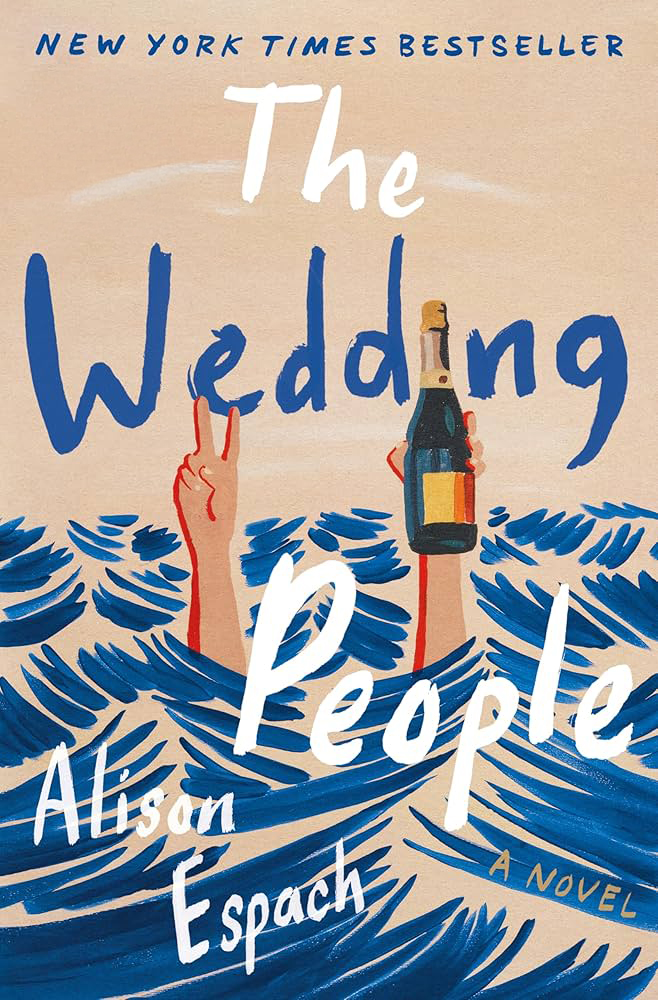
Elena Bowes caught up with American author Alison Espach to discuss her darkly comic book The Wedding People. Espach shows how the darkest moments can also be the funniest, and how grief can set us free.
In the novel, the main protagonist Phoebe has come to a gorgeous hotel in Newport, Rhode Island that she can barely afford with no luggage, wearing an emerald silk dress, gold heels that hurt and the thick pearls that her husband who has left her gave her on their wedding night. So, a very mysterious and not happy start. Phoebe is then confronted with the wedding people, this happy bunch of strangers who are staying at this same hotel for what’s supposed to be a very happy occasion.
Below is an edited Q&A. You can listen to the full interview here on Elena Meets the Author, or wherever you listen to podcasts.
Alison, how did Phoebe, who starts the book in utter despair, come to you?
She came to me a while ago – 6, 7, 8 years ago. I was in the middle of working on my second novel, Notes on Your Sudden Disappearance. I really needed a break from that book. I thought it was getting a little heavy, a little dark.
I was writing about death at the time. One of the characters was dying. So I was like, you know what, why am I doing this to myself? Why don’t I write a fun book, a breezy book, a woman going on vacation, going to this very luxurious hotel. I didn’t really know why she was going there. I just knew I wanted that to be the setting.
I thought it would be really fun if there was a wedding set there. I love weddings. I used to work at weddings. That’s how I know I love them. I still enjoyed them even as a worker.
I was writing that opening scene and the bride character, Lila, is obsessed with the fact that everyone at this hotel is supposed to be there for the wedding. But she knows Phoebe is not there for the wedding. So, Lila keeps asking, why are you here? I knew nothing about Phoebe other than she didn’t have luggage. She was waltzing into the hotel on a whim. I tried out a few possibilities, like she’s here to have an affair or she’s here as an assassin or there’s a murder mystery. And I ended up writing, ‘I’m here to end my life.’
And that really surprised me and disappointed me at the time. Because it was like, Oh, she’s sad. She’s a very sad woman walking into this hotel and that’s at odds with the happiness that the bride demands. I knew it was the story because what is more opposed to a happy wedding than a woman who thinks she’s at the end of her life?
But I didn’t want to write that. This is supposed to be my fun book. So, I put it away for a couple of years, but I still thought about Phoebe.
So you put it away to work on your second novel, Notes on a Disappearance?
Yeah, that’s a fictional novel. It was inspired by the loss of my own brother when I was a teenager, when we were both teenagers. I knew I wanted to write about that at some point in my life. It was such a dominant experience of my life. I tried writing it as a memoir, but it just wasn’t for me. I really needed some distance from that story in order to turn that grief and my experiences into an actual story.
It just strikes me as kind of darkly funny, that when you took a break from your second book and you started this supposedly lighter book, Phoebe says she wants to kill herself. So even though you’re trying to be light, death still comes through to you.
I really thought after writing Notes on Your Sudden Disappearance, it’s going to be a whole new world for me. You know, I got that out of my system. I can move on. But no. I ended up putting [The Wedding People] away for a few years because I was scared of it and tired of it. When I returned, I saw it in a much lighter way, I was able to see the comedy of the situation. Sometimes when our despair is in the face of someone else’s total indifference or obliviousness, that can either be a tragedy or that can be hilarious.
Definitely. Hilarious. When you were writing this book, did you start with that first chapter of Phoebe seeing everyone checking in for the wedding or the later elevator scene where she confesses to the all-consumed bride that she’s come to this hotel to kill herself?
I started with Phoebe arriving at the hotel. And then worked my way into that elevator scene. That first chapter looks about the same, in terms of plot points as when I started.
I didn’t really know what I was doing until she was in that elevator with the bride. Phoebe says, ‘I’m here to end my life’ and, the bride says, ‘No, it’s my wedding week. And you can’t do that.’ When I came back to the novel, after abandoning it for a few years, I realized that was actually my voice.
People always think I’m Phoebe, but in some ways, I’m also Lila, right? That, that self-policing of sadness, saying, you can’t be sad now, or you can’t write a sad book. Not that I think this is a sad book, but I was afraid, oh, here I go again writing about something too dark.
She’s come to the hotel to kill herself and somehow her grief frees her to be truly honest because for the first time in her life, she doesn’t care what people think of her. She doesn’t need to be liked.
That seems like an upside to grief, no more pretence, no more having to say the right thing. Do you think a little grief is good for us, and wouldn’t it be nice if we didn’t need grief to be more honest?
That is true. I agree that it would be nice if we didn’t need grief or some horrific life altering event to do it, right?
If I’m thinking back to the years following my brother’s death, my grief. did allow me to be free in a way that most teenagers do not feel free, right? Because I thought, oh wow, here I thought all these things mattered. I was working so hard to look a certain way and talk a certain way and get certain grades and all these things that teenagers really care about, are really small things. I think you’re onto something right? Grief frees us from our pedestrian concerns.
You do dialogue so well. Here’s one two sentence exchange between the self-obsessed bride, telling suicidal Phoebe now is not a good time to end her life, “This is the most important week of my life,’ the bride pleads. ‘Same,’ Phoebe says.” Does your dialogue just come to you?
I would say when I first started writing, I was a very dialogue heavy writer. It comes to me most naturally. As I got older, I had to really learn how to write setting. I had to deliberately learn certain elements of craft. Dialogue was always the lifeblood of my writing and the books that I loved were always so dialogue heavy. I just I love talking.
At what point did you realize that Phoebe needed to be a stranger in the story to get the other characters to open up to her?
That was also baked in from the start. I love the stranger’s perspective on things. I love when the character is watching something from afar. The stranger is able to see something that characters who are closer to the action miss, right?
I suppose if she’s suicidal she’s even more of a stranger because she feels even more apart.
She’s in a whole world of just her emotions. And everyone else at the wedding is committing to this role for a few days, being their best self. And Phoebe has actually committed to the opposite. No more pretending.
I was really intrigued by how Phoebe’s confessional spirit, how that would become contagious. How her honesty and frankness would actually start to rub off on these wedding people and serve as this very tempting way to be.
There’s a lot of death in this book, although that should not turn readers off. The deaths have already happened before page one, and they’re more in terms of how they shape those left behind. A lot of people are grieving but pretending not to be in pain. Can you talk about grief and societal pressure to pretend you are okay when you’re not?
I suffered from that for a long time. Because I was a teenager when I was grieving and almost no one else I knew was, so I was really trying to hide it. I carried that through for many years into my twenties. It’s like an extra form of grieving on top of the grief. Managing your grief for other people. I really try not to do that anymore.
You mentioned something in another interview, about how when you used to take creative writing classes, and the teacher would ask the class to figure out all the traits of these different fictional characters.
You had a really hard time with that. What worked for you was having one thing only that you knew about a character. And then you could go on from there. You said that you liked the process of figuring out who that person was, from knowing only one thing at the beginning. Can you expand on that?
That is something that I really love about fiction when fiction writers take someone who seems like a stereotype and then increasingly complicate that stereotype. It mirrors my experience of knowing people. Like if you are meeting a stranger or you’re seeing someone across the way at an airport or at a wedding, you don’t have that much information to work from.
You make an assumption about them.
I just love in life when I make this quick judgment about someone and I love it when it’s especially negative, right? I’ve had so many experiences where I get to know a person and I discover they’re the opposite of what I thought.
I loved how your book deals with so many heavy life issues like loneliness, life not turning out how you had hoped it would, the betrayal of someone you love, and of course, someone you love dying, and you deal with them all with some humour.
Can you explain how you think humour helps us in our darkest moments?
Humour is, is one of the key things that helps me in my darkest moments. The most profound experience of grieving that I had was losing my brother, and I remember thinking I am never going to laugh again. I don’t see how anything could be funny.
I don’t see how as a family we could ever laugh again. When we’re really in a dark place, we can be very black and white, very apocalyptic.
Humour has surprised me the most because you don’t plan for it. It just happens. It’s spontaneous. I remember the first day that we found out that he had died, I invited one of my best friends over, just to have some company. And we were struggling in conversation. Who knows what to say in that moment. And so, she said at some point, you know, our other friend, she’s really mad at us right now because you didn’t invite her and only invited me.
The day before his death, that comment would have made me nervous, like, oh no, someone’s mad at me. But on the day of his death, because of what was going on, we just started laughing hysterically, almost in a trauma like way. The ridiculousness, the absurdity.
And that was such a stupid small thing. But I do think it was key in reframing the whole thing. I wasn’t planning on laughing today, but I did. And I couldn’t have predicted how I would have laughed so it just opened the door, you don’t know what’s coming. Sometimes that’s all you need.
If the easiest part of writing this book was the dialogue, what was the most challenging?
Pushing myself to consistently be honest throughout the book. There were a few parts where I stopped writing for a few months or so mostly because I didn’t feel like going to that dark place, or because I didn’t feel like being in the headspace of someone who is about to take a bunch of cat painkillers.
And so, it’s not because I didn’t want to write these things. I would have had no problem writing them if I knew no one was going to read them. But there was just something about wanting to hide my sadness or grief.
I think (other) writers feel that too. That you avoid in your fiction what you tend to avoid in life. So, I felt like, Oh no, if I write this dark character, everyone’s going to think I’m her. Or if I display a knowledge of sadness and grief, people are going to think I’m sad, you know, and not wanting to be perceived that way.
I had to coach myself through those parts. I found that challenging, but ultimately the most wonderful part of writing this book. And now getting to connect with people over it and finding that people are pretty receptive to those kinds of conversations. Whereas I had only imagined all the negative things they would say.
Well, that’s all my questions.
Thank you so much, Elena
Thank you!