

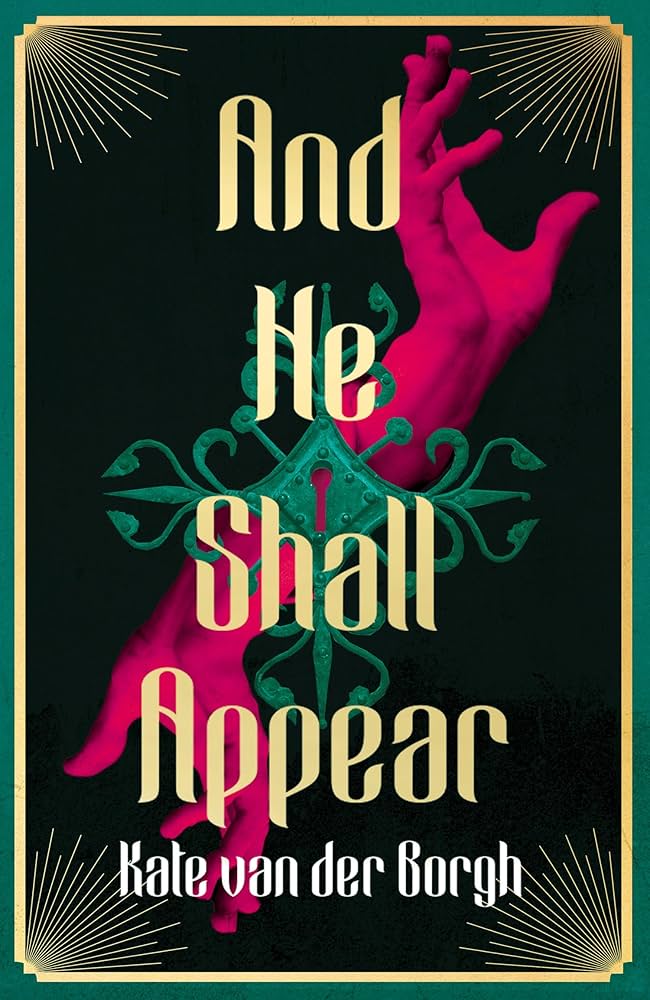
And He Shall Appear is the stunning debut by 26 member, Kate van der Borgh. When the young, working class narrator goes to study music at Cambridge, he’s delighted to make friends with Bryn Cavendish: wealthy socialite, campus charmer and talented amateur magician. However, the narrator soon starts to suspect that Bryn’s charms are more sinister than they first appeared – even supernatural.
We thought it would be interesting to try a partner to our usual Author Q&A piece – flipping the format on its head with a “Reader Q&A.” Here Kate poses the questions to 26 director, Andy Hayes.
Kate: I’ll kick off with the biggest question of all: what do you think the book is about?
Andy: I don’t think there’s one definite answer, and it’ll be interesting to compare what I took out if it as the reader with your intention as the author. There’s a positive tension there, I like that.
You introduce the idea of Saudades early on, ‘a Portuguese word that describes regret for days gone by.’ And I think that is essentially what the book is about, with the themes of deception and devotion feeding into that.
Bryn, the key focus of the book, is magnetic, a master of deception, a charismatic performer of magic with dark undertones. He’s at the epicentre of college life, the other students want to be near him or be him. He’s actually a bit of an arsehole, but it takes a while for this to become apparent to the narrator, who’s devoted to him, just like Bryn’s girlfriend, Alexa. And the narrator is devoted to her too. The narrator is never named, is that right? Have I missed something obvious? I’m interested in your decision not to name him.
More on deception, memory plays a role here. What is remembered is open to interpretation. Is the narrator is reliable? Is he deceiving us or deceiving himself? Can we ever totally rely on our own memory? Is Saudades regret for what we think, or hoped, happened in days gone by?
You’re right about the narrator being unnamed. Since he’s struggling to work out who he is – and since he feels so undistinguished in his new Cambridge environment, so pushed-and-pulled by everyone else – it made sense to me that the reader would never know his real name, and that they’d only ever know him through the nicknames bestowed by other people.
I’m impressed that you picked up on Saudades, because regret for lost days is a hugely important idea in the novel. Perhaps some people assume that this is a horror story about shadowy cloisters and theatrical scares – but, to me, it’s fundamentally a sad story about a man who is so stuck in the past that he’s lost sight of the future. That, for me, is truly horrifying.
I’d add that class and belonging are important too. The narrator’s move to Cambridge puts him in a strange position: his friends from home now think him ‘posh’, his college friends see him as very working class. He’s in this odd, almost liminal space, neither here nor there, which is quite ghostly in itself. He comes to see that, however successful he becomes – in his studies or beyond – there are certain circles he’ll never quite break into. And on some level he feels like that society has broken its promise that university is his key to his dream life.
Given that, in the novel, Saudades is the name of a musical work, let’s turn to music. What role do you think music plays in the story?
Music plays a hugely important role. It’s the narrative glue that holds the story together. The reason the narrator gets a place at Cambridge. The reason he builds a relationship with Bryn, and the other key character, Alexa. It’s also the reason he goes back to Cambridge at the end. So it bookends the story in a neat way.
I wasn’t familiar with a lot of the pieces you refer to in the text. I couldn’t hear them in my head. Perhaps ‘hearing’ the music would add another dimension to the reader’s experience. That wasn’t a problem, as you describe them well and they made sense in the story, so it didn’t matter. Music hits me in the heart rather than the head. I also love discovering new music so I’m going to go back through the novel and have a listen to all the pieces you mention. Any chance of a playlist?
I do know Shostakovich though, or at least some of his work, partly because you’ve banged on about him in the past! I love Julian Barnes’ novel, The Noise of Time, about the composer, his bags permanently packed waiting for a knock on the door from Stalin’s secret police as you reference in the novel. Our narrator hears knocking at his door at night, knocking that only he can hear. The knocks are musical, a terrible insistent percussive beat leaving him in a permanent state of awful expectation and anxiety.
Warlock is another composer who’s key, what a name! ‘A man who practices witchcraft.’ But I appreciate there’s more to him than that. You talk about him in the book, but please give me a quick reminder!
Are there any musical devices you utilised in the novel; its pace or structure for example? And did the discipline of your musical training help you knuckle down and write the book?!
The discipline of musical training definitely helped! As a kid I’d practise the same four bars of piano for an hour or more, and writing a novel means reworking the same scenes over and over.
And yes, there’s a playlist here, created by a very kind reviewer.
I wanted the narrator to love early 20th Century music because it’s often perceived to be nostalgic. Composers created these mournful, lyrical pieces, drawing on English folk tunes, seeming to pine for a lost age (which is exactly what the narrator is doing). But – to add another layer here – there’s a view that many weren’t being nostalgic at all, and that we’re imposing our own nostalgia on their work. So, nostalgia becomes a tricksy thing, for us and for the narrator.
The novel doesn’t have a musical structure in itself, but Bach’s Crab Canon shows up at a key moment. This is a piece featuring a line of music played forwards and backwards simultaneously, which reflects the narrator’s life: even as time is marching on, he’s being pulled back into the past.
Peter Warlock is marvellous. He was actually born Philip Heseltine and changed his name (another clue that names are important in the story). In a superficial way Warlock is important because of his interest in the occult. But the bigger thing is his slightly unknowable identity. Was he the beer-swilling lout his contemporaries thought him to be, or was he a more subtle and sensitive figure altogether? It’s a question the narrator ends up asking of Bryn.
Perhaps though, the biggest role of music in the story is as a driver of memory. When we hear music from our formative years, the years fall away and we feel as if we’re back in a certain moment and place. It’s like the memories that are tied to music are full-body memories, so much more powerful than ordinary memories that seem to live solely in the brain.
(By the way, nice of you to mention Julian Barnes, as The Sense of an Ending is a big influence on this book.)
OK, last questions from me. Is there a hero in the story? Is there a villain? If so, who?
There are heroes and villains in the story.
Bryn is the obvious hero and the villain too, an anti-hero if you will. The first time we see him he’s dressed as the devil, and I think we always view him through this lens. First impressions and all that. He’s captivating, mesmerising and draws people in; always the centre of attention and that’s where he wants to be. But anyone who crosses him pays a terrible price.
Boys often see their dads as heroes, at least when they’re young. You draw a parallel here between Bryn’s dad and the narrator’s. Both should be heroes, but they’re actually villains.
Both have rejected and abandoned their sons in their own way. Bryn’s dad is a magician who found fame but is in a downward trajectory. Bryn wants to be like him, he even goes to the same college and tries to emulate him. He seeks his father out, but never sees him, he’s a ghost-like presence throughout.
The narrator’s own father is an alcoholic who tries to be a decent father but fails. Repeatedly. He’s not there for his wife or his son. We see him through his son’s eyes, and one particular instance is the perhaps the most haunting passage in the book for me.
Like Bryn, Warlock is a hero to the narrator, and to you. And the narrator’s disappointed when Bryn doesn’t get into him in the same way that he is. Mutual appreciation can make a friendship. Mutual dislikes can too. But it’s hard to build a friendship where there’s no common ground.
The biggest question the story poses is if the narrator is a villain or not. He’s upfront about this from the start, so I’m not adding any spoilers here. He thinks he’s a villain, but as the story unfolds he explains that, even though he doesn’t see himself as a hero, he’s only trying to do the right thing. The story handles this tension really well and deftly takes us through the unintended consequences of this. It’s resolved in a totally unexpected twist at the end which was really satisfying for me as the reader.
Does a story need a hero and a villain? I think so. And I like it that these archetypes in your book are not clear cut; so give me shades of grey over black and white any day!
Ha, you’re right that there’s no black and white here. I love ambiguity in stories and there’s definitely space for readers to interpret my characters in different ways.
The only thing I’d add is that we only ever see people through the narrator’s eyes. We get hints that other people see Bryn differently to the way the narrator sees him. And so the book raises a question about how we remember and talk about other people, how we can make heroes and villains of them depending on how we see the world. Speak of the devil and he shall appear…
Thanks for your reading, Andy!
Thank you for your questions, Kate. And 26 people, I’d highly recommend this book.
And He Shall Appear is available in hardback now and is published by 4th Estate.
– Andy Hayes
If anyone knows an author they would like an excuse to chat to, and would be interested in reviving this flipped format alongside Elena Bowes’ monthly staple, please get in touch with max@whiteweavearts.co.uk